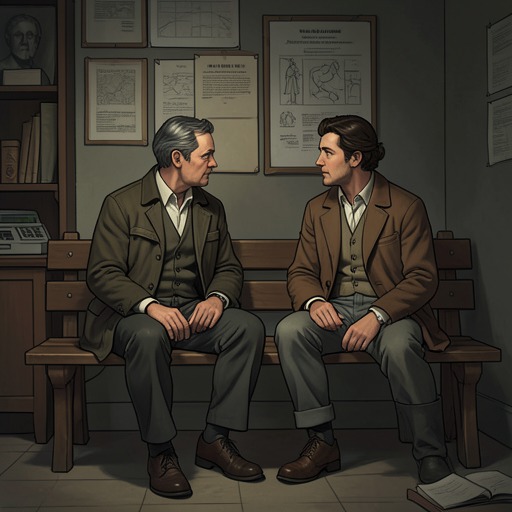
Ryuji's note to Watanabe
Norwegian WoodMidori’s folded note is a direct attempt to reach Toru Watanabe at the moment his grief has made him emotionally absent. Written on ruled paper while the two are sitting together, it tells him that she had hoped to spend the night at his new place, but that his inattention has left her sad and feeling shut out. The note’s movement from a complaint about her unnoticed hairstyle to an intimate imagined evening, and finally to a request that he not speak to her, gives the small piece of paper the force of a relationship turning point.
The afternoon and the note
After a springtime scene at a café, Midori and Watanabe walk around the neighborhood. They browse second-hand bookshops, buy books, have another cup of coffee, play pinball, and sit on a park bench. Midori does most of the talking; Watanabe, distracted, mainly grunts in reply. When she says she is thirsty, he runs to a newsagent’s for two Cokes. While he is away, she writes on ruled paper with a ballpoint pen.
When Midori announces that she must meet her sister in Ginza at 3:30, they walk to the subway station and separate. As she leaves, she slips the paper, folded in four, into Watanabe’s pocket and tells him to read it at home. He reads it on the train. The note is therefore composed in his presence but delivered for private reading: Midori’s words reach him only after the afternoon in which he has failed to hear what she is trying to communicate.
What Midori tells him
Midori describes the note as her first letter to someone sitting beside her on a bench, and says that writing seems the only way to get through to Watanabe. She calls out the gap between physical closeness and emotional attention: he is beside her, but scarcely listening. The written form allows her to say plainly what she has not managed to make him notice face to face.
Her sharpest grievance is specific. She has been growing out her hair and finally achieved a style she considers girlish; she hoped to surprise him the first time they met after a long interval. Watanabe does not notice. Midori says that even a simple compliment about her hair would have been enough to forgive his distraction, but he has not even given her a decent look. The hairstyle becomes a concrete test of whether he sees her as a person present in front of him, rather than as someone waiting outside his thoughts.
The note then reveals that Midori’s stated appointment with her sister is a lie. She had actually planned to spend the night at Watanabe’s new place and brought both pajamas and a toothbrush in her bag. She regrets that he never invited her to see his new home, but does not conceal how much she had hoped for more than an afternoon together. Her imagined alternative is domestic and intimate: she would have made him dinner, and they would have gone to bed and cuddled. The disclosure makes clear that her anger is bound up with desire and disappointed expectation, not simply annoyance over a missed compliment.
Hurt, withdrawal, and consequence
Midori distinguishes sadness from anger. She remembers how kind Watanabe was when she was having problems, and now finds herself unable to help him while he is having his own. She describes him as locked inside a private world: when she knocks, he looks up briefly and returns to it. In the scene, his return with the Cokes does not break that enclosure. He remains absorbed in thought, and she keeps waiting for him to notice her hair; when he does not, the possibility of going home with him disappears.
The note ends with a curt goodbye and a postscript asking him not to talk to her the next time they meet. That request converts her unspoken hope for closeness into an immediate boundary. After reading the paper, Watanabe calls Midori’s flat from the station in Kichijoji, but there is no answer. He tries again later; her sister says Midori has not returned and does not know when she will. Watanabe attempts to write to Midori after dinner, gives up after several false starts, and writes to Naoko instead. The sequence shows the note’s consequence without resolving the hurt it exposes: Midori has made herself understood in writing, while Watanabe still turns away from the living relationship he has been asked to meet.
Form and significance
The note’s folded paper and delayed reading shape its emotional action. Midori is beside Watanabe when she writes, yet she has to put her appeal into a form he can read later because spoken conversation has failed to hold his attention. Its details are deliberately ordinary—the changed hairstyle, the two Cokes, the pajamas and toothbrush—but together they disclose an unspoken plan and the disappointment of seeing it collapse. The intimacy she imagined is not abstract: it is a dinner, a shared bed, and the hope that he might first notice her.
That small, domestic possibility stands in contrast to Watanabe’s inward preoccupation with Naoko and his difficulty responding to Midori’s presence. Midori’s note does not cure his withdrawal or settle their relationship; it makes the cost of that withdrawal legible in her own words. Its final request not to speak to her is both the sharpest rebuke and a sign of how much she had wanted him to answer before she left.